
You flip a package over, stare at the grid on the back, and your eyes glaze over. Serving size. Calories. Percent Daily Value. Grams of something. It should be simple. It isn’t, mostly because nobody ever taught you what each section actually means or why the order the numbers appear matters. That gap costs real money, real health, and real confidence at the grocery store.
Reading a nutrition label is a practical skill, the kind you can build in a single session with the right framework. Once you know the five zones to check first, you stop guessing and start choosing. The same logic that decodes a cereal box also helps you navigate the Chipotle nutrition calculator online, the McDonald’s nutrition builder at the counter, or any packaged food you grab off a shelf.
Santiago Ybarra, a nutrition educator who develops hands-on cooking and food literacy programs for communities, youth, and families, treats label reading as the first foundational skill in every workshop. “When people understand what they’re looking at,” he says, “they make different choices, not because we told them to, but because the information clicked.” At Healthy Living Inc., our customized nutrition education programs build exactly this kind of practical food literacy, starting with the panel on the back of the bag.
What Is a Nutrition Facts Label?
A Nutrition Facts label is the standardized panel required on most packaged foods in the U.S. It lists calorie content, macronutrients, micronutrients, and ingredient information per serving. The FDA updated the format in 2020, making calories larger, adding “added sugars” as its own line, and updating serving sizes to reflect real-world eating habits. According to the FDA, the updated Nutrition Facts label is designed to help consumers make better-informed food and beverage choices based on portions people actually eat.
The label divides into five functional zones: serving information at the top, calories, nutrients to limit, nutrients to build up, and the percent daily value footnote at the bottom. Each zone answers a different question. Most people read calories and stop. That’s a mistake. The nutrients-to-limit section and the ingredients list together tell you more about a food’s long-term health impact than the calorie count alone ever will.
How to Properly Read Nutrition Labels?
Start at the top and work down in this exact order: serving size first, then calories per serving, then nutrients. Confirm whether you’ll eat one serving or two, because every number on the label scales with your actual portion. Then scan sodium, added sugars, and saturated fat before looking at fiber, protein, and vitamins.
Follow this sequence every time:
- Serving size and servings per container. This is the multiplier for every other number. One “serving” of crackers might be five crackers. Most people eat twenty.
- Calories per serving. Multiply by your actual portion before drawing any conclusions.
- Nutrients to limit. Saturated fat, sodium, and added sugars. These are the three most linked to chronic disease when consumed in excess over time.
- Nutrients to build up. Dietary fiber, vitamin D, calcium, iron, and potassium. Most Americans are short on all five.
- Percent Daily Value (%DV). Five percent or less is low; 20 percent or more is high. Use this as your fast screen when comparing two products.
- Ingredients list. Listed by weight, largest first. If a form of sugar appears in the first three ingredients, treat the product as sugar-heavy regardless of what the front of the package says.

What Is the 4-4-9 Rule in Nutrition?
The 4-4-9 rule describes calorie density by macronutrient: carbohydrates yield 4 calories per gram, protein yields 4 calories per gram, and fat yields 9 calories per gram. Every nutrition calculator, including the Chipotle nutrition calculator and the Chick-fil-A nutrition tool, uses this formula to convert grams of macros into the total calorie estimates you see on a menu or label.
Why does this matter for everyday label reading? Because fat packs more than twice the calories per gram as carbohydrates or protein. A food that looks modest in grams of fat can still be calorie-dense. A tablespoon of olive oil carries about 14 grams of fat; at 9 calories per gram, that’s 126 calories from one tablespoon. Not a reason to avoid it, olive oil has real nutritional value, but a reason to understand the math behind the number you’re reading.
When you look at avocado nutrition facts, this rule explains why a single medium avocado delivers around 230 calories despite having minimal sugar and no refined carbohydrates. The fat (roughly 21 grams, mostly unsaturated) accounts for most of that. Compare that to sweet potato nutrition: mostly carbohydrates at 4 calories per gram, lower calorie density, high fiber, high potassium. The macro breakdown tells the story. The same logic applies to banana nutrition (about 27 grams of carbohydrate per medium banana, virtually no fat) and to products like Optimum Nutrition Gold Standard 100 Whey Protein Powder, which prominently displays its macros because the entire product value is in its protein-per-serving ratio.
How to Read Food Labels for Healthy Eating
Healthy eating doesn’t mean finding the lowest calorie label. It means identifying foods with high nutrient density relative to their calorie count, adequate protein for satiety, fiber for gut health, and limited added sugar and sodium. The label is your comparison tool, not a grading system.
“Diets higher in dietary fiber are associated with a reduced risk of cardiovascular disease, type 2 diabetes, and colorectal cancer.”
Fiber is one of the most underused numbers on any label. Most adults consume less than half the recommended daily intake. When you’re choosing between two bread options, a difference of 3 grams of fiber per slice adds up across a week of eating. Compare banana nutrition (about 3 grams of fiber per medium banana) to a processed fruit snack with zero fiber and you immediately see which one keeps you fuller longer. That comparison takes ten seconds with a label and zero seconds with whole fruit that has no label at all.
What to Watch For: The 8 Label Sections That Actually Matter
- Serving size (read this first, every single time)
- Calories per serving (scale to your actual portion before judging)
- Saturated fat (keep below 10% of total daily calories per the 2020 Dietary Guidelines)
- Sodium (target under 2,300 mg/day; a single fast food meal can hit that ceiling)
- Added sugars (this line, new in 2020, separates natural from processed sugar)
- Dietary fiber (aim for 25 to 38 grams per day depending on age and sex)
- Protein (critical for satiety, muscle maintenance, and metabolic function)
- Ingredients list (shorter is usually better; learn the alternate names for added sugar)
Using Digital Tools: How the Chipotle Nutrition Calculator Fits In
Chain restaurant nutrition builders, including the Chipotle nutrition calculator, the McDonald’s nutrition tool, and the Chick-fil-A nutrition page, apply identical label-reading logic to customizable menu items. You’re still reading serving sizes, calories, sodium, fat, and fiber. The difference is that you’re building a meal in real time instead of reading a static package.
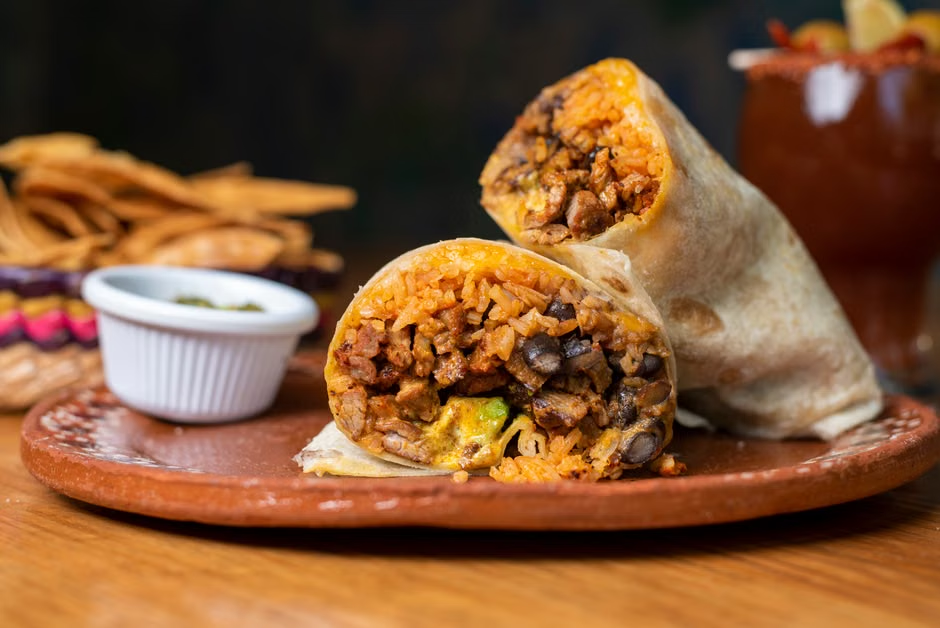
These tools are genuinely useful, with one caveat. They show macros and calorie counts, but they don’t show ingredient quality, processing level, or the nutrient density that tells you whether a meal is nourishing or just calorie-adequate. A 700-calorie burrito bowl built with brown rice, black beans, fajita vegetables, guacamole, and salsa carries a very different nutritional profile than a 700-calorie bowl built with white rice, sour cream, cheese, and carnitas, even if the calorie number matches exactly.
“Consumption of ultra-processed foods is associated with increased risk of weight gain, cardiovascular disease, type 2 diabetes, and certain cancers, independent of their nutrient content.”
Use digital calculators as starting points, not report cards. The same label literacy that helps you read a package helps you make smarter decisions from a digital menu builder. Both are forms of food literacy, which is exactly what our community nutrition outreach programs teach across workshops, health fairs, WIC partnerships, and summer programs.
When Label Reading Isn’t Enough (And What to Do Instead)
Labels only exist on packaged foods. Fresh produce, bulk grains, unpackaged proteins, and most restaurant items don’t carry them. Avocado nutrition facts, sweet potato nutrition, and banana nutrition are widely published and searchable, but you won’t find a panel on the produce rack. That’s not a gap in the system; that’s a feature. Whole, minimally processed foods generally don’t need elaborate interpretation.
If you’re managing a health condition, especially type 2 diabetes or hypertension, label reading becomes a clinical skill as much as a practical one. The carbohydrate line combined with the fiber line gives you net carbs; that calculation matters directly for blood sugar management. Sodium tracking requires reading every processed item in a meal, not just the obvious salty ones. A registered dietitian or your care team can help you apply label reading to your specific health needs. For older adults, our seniors nutrition programs offer hands-on label reading practice tailored to managing chronic conditions through daily food choices.
6 Practical Tips for Reading Labels Faster
- Always check serving size first. Before you read any other number, confirm what one serving actually means. Recalculate everything if you plan to eat more than one serving.
- Use %DV as your quick screen. Five percent or less is low; 20 percent or more is high. You don’t need to memorize gram targets if you use this rule consistently on every label.
- Scan added sugars separately from total sugars. The added sugars line shows you how much sugar was put in during processing, separate from sugar that came with the food naturally.
- Read the ingredients list in order. The first three ingredients make up most of the product by weight. If any sweetener appears in the top three, treat it as a sugar-heavy food regardless of what the front label claims.
- Compare sodium across similar products. Sodium varies wildly between brands of identical foods. Two cans of tomato sauce can differ by 400 mg per serving. This single comparison can reduce your daily sodium intake by 30 percent or more over a week.
- Choose fiber wherever you can. When choosing between two similar products, the one with more fiber almost always wins for satiety, gut health, and blood sugar stability. Apply this to breads, cereals, crackers, and pasta every time.
In our hands-on programs, participants practice these comparisons live, two brands side by side, and learn to make the call in under 60 seconds. That speed matters at the grocery store. You’re not studying for a test; you’re shopping for your family. The goal is fluency, not perfection, and fluency comes from repeating the same six-step sequence until it becomes automatic. To bring this kind of practical food literacy to your school, camp, shelter, or community organization, our customized nutrition education programs are built specifically for organizational partners who want real skill-building, not a lecture.
Label reading is a foundation skill. Build it once and carry it into every grocery trip, every restaurant order, every decision at the counter. You don’t need to memorize every number. Know which five lines to check first, scale the numbers to your actual portion, and use %DV as your fast filter. Start there. Practice it this week on three products you already buy. The information has been on the back of the package the whole time. Now you know exactly how to read it.